Alex Kendall Recognizes Wayve’s Potential with Softbank Sleep Incident
Masayoshi Son, the prominent tech investor, is known for his unconventional investment tactics, including a $20 billion deal with Adam Neumann, the founder of WeWork.
Alex Kendall, the founder of Wayve, a pioneering company in the driverless car sector, refrains from disclosing whether he encountered a similar moment when Son chose to invest in his firm.
However, Kendall noted that Son did take a nap in the back of one of Wayve’s autonomous vehicles during a test drive in Japan, which Kendall interpreted as a positive sign — a testament to the comfort and safety demonstrated by Wayve’s technology.
It has been a year since Wayve secured a remarkable $1 billion in funding during an investment round headed by Softbank, with participation from major players like Nvidia and Microsoft.
These industry giants had been closely monitoring Kendall’s progress. A chance encounter with Nvidia’s CEO, Jensen Huang, in an elevator in 2018 led to Microsoft investing $200 million in Wayve’s subsequent funding round in 2022.
The recent “Series C” round of funding is not expected to be the final one. Kendall, now 32, mentioned, “We’re always fundraising, but at this moment, we are fully capitalized and concentrating on product development.”
This significant influx of capital has propelled the London-based firm into the forefront of the artificial intelligence landscape, positioning it as a top contender in the UK and global tech scene. Wayve operates hubs in San Francisco, Stuttgart, and Yokohama, and has successfully implemented autonomous driving in 90 cities within the last three months.
Since receiving the investment, Wayve has enhanced its technology. The car’s sensors are now capable of interpreting pedestrian movements, predicting whether individuals intend to cross the street based on their body language.

Kendall expressed his excitement when, in Tokyo, one of his vehicles effectively responded to a Japanese traffic warden’s hand signal, complying with the stop and wait instruction. Remarkably, this was achieved without the vehicle being trained on local data.
“This funding was a monumental turning point for us,” Kendall stated. “It provided the resources necessary to transform our technology from a prototype into a dependable product that is accepted throughout the automotive realm and capable of functioning in both consumer and commercial vehicles.”
Kendall co-founded Wayve in 2017 after earning his PhD in deep learning, computer vision, and robotics at Cambridge University at the age of 25. The inspiration for the company’s name stemmed from Kendall’s surfing experiences on Auckland’s beaches during his university days.
In a Cambridge garage, alongside fellow student Amar Shah, Kendall started automating a small electric Renault Twizy. They refined the algorithms until the vehicle could autonomously navigate around the block, requiring minimal human input every hundred meters. This prototype now resides at their headquarters in King’s Cross.
Wayve partners with delivery services like Asda and Ocado but does not manufacture cars. Instead, its AI-based system learns from data, enabling vehicles to autonomously drive rather than simply following rigid instructions or routes. The company believes this method offers greater flexibility and scalability compared to others, as it allows for adaptation to various environments.
For instance, rather than being explicitly programmed to slow for speed bumps, the vehicle learns this behavior through observing others in similar contexts. It manages to navigate the complexities of London traffic confidently, including merging lanes and responding to fleeting green lights.
Kendall takes pleasure in highlighting hazardous situations while monitoring how the car reacts. Our conversation is interspersed with his insights on traffic dynamics, reminiscent of sitting beside a driving instructor with extensive expertise in advanced AI technology.
Notably, Kendall’s autonomous vehicles have also hosted other recognizable figures, including Bill Gates and Sir Richard Branson. There’s a certain thrill in experiencing a driverless ride through the busy streets of London.
Wayve’s investor roster includes renowned names from the AI arena, such as Ilya Sutskever, co-founder of OpenAI, and Yann LeCun, chief AI scientist at Meta. Additionally, Wayve collaborates with Uber to explore the integration of self-driving vehicles into its service network.

Establishing its base in King’s Cross amidst the bustling city might seem counterintuitive; however, Kendall believes tackling the toughest challenges from the start is crucial. With its historical layout, congested traffic, unpredictable weather, and the prevalence of jaywalkers, central London presents unique obstacles.
Kendall remarked, “Setting up here compelled us to create a solution that could scale effectively. We developed an intelligent system capable of not only adhering to protected signals at intersections but also learning to navigate and predict the behavior of surrounding traffic.”
In April, Wayve announced its first partnership with a major automobile manufacturer, Nissan, which will feature its software in Nissan vehicles starting in 2027.
Though Wayve’s technology may appear ready for deployment, the regulatory landscape in the UK is lagging. The anticipated 2026 timeline for legislation permitting driverless vehicles has now been pushed to late 2027 to accommodate further legal considerations. Despite some allowance for certain self-driving features, such as lane-keeping, drivers must remain in control at all times.

Kendall has played a role in shaping these legislative discussions. Is he frustrated by the delays? He diplomatically suggests, “It’s vital that we don’t fall further behind.”
Other regions are advancing with their regulations, while competing firms are quickly advancing as well. Waymo’s presence is expanding across more US cities, posing competition to both Tesla and Chinese players like BYD, Baidu, and WeRide’s autonomous taxi services.
Given these trends, it is plausible that Wayve may launch its driverless technology in markets outside the UK before it is allowed to operate domestically. While Kendall has not specified which city will debut its vehicles, London remains one of the “top priorities.”
“The regulatory environment in the US is progressing more efficiently. We also observe that automotive manufacturers in Asia and America are ahead of those in Europe concerning market size, regulatory frameworks, consumer acceptance, and operational support,” he explained, adding that these elements will be critical in determining their next steps.
Kendall has never owned a car, yet he remains enthusiastic about the innovations he contributed to. He commented, “One of my favorite activities is taking our autonomous vehicles for a spin through Soho on Friday nights. The busy atmosphere provides fantastic scenarios to witness. Experiencing the intelligence of our system navigating through crowds safely is exhilarating. Those moments truly offer a sense of joy.”
With a grin, we transition onto the bustling road…
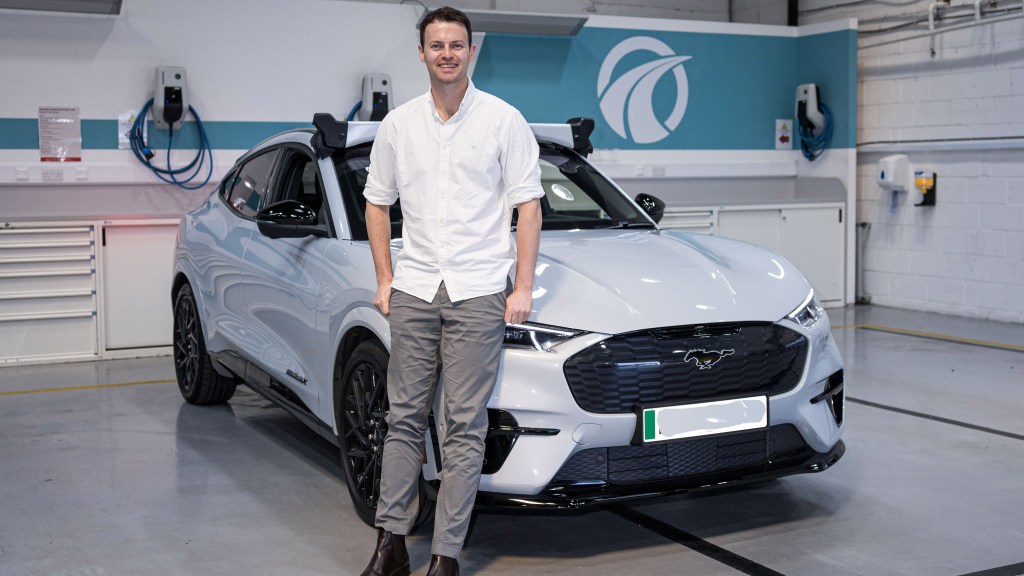
On a hot day during half-term, central London buzzes with activity. With Alex Kendall smiling beside me, we pull away from the busy York Road in King’s Cross. The safety driver quickly removes his hands from the wheel, allowing the computer system to take charge.

The steering wheel autonomously turns as the vehicle advances through the congested London streets. Obstacles abound: pedestrians emerging from behind parked cars, temporary traffic signals, ongoing roadwork, electric bikes, and car doors opening. The vehicle navigates these challenges with impressive ease, passing ambulances at Great Ormond Street Hospital as we make our way through Bloomsbury and encounter excited children outside the British Museum along with distracted tourists. While idling in traffic, a passerby notices us and curiously peers through the window. I wave back, illustrating the novelty of this experience in London compared to the more familiar scenes of San Francisco. Since my last ride with Wayve a year ago, the technology seems to have significantly improved.
Post Comment